Former RECA Legislation
As awareness of the harms of nuclear testing and uranium mining grew, impacted communities began calling on the government to support harmed communities. Many of these communities also sued the U.S. government for harm. Finally, in 1990, Congress enacted the Radiation Exposure Compensation Act, or RECA, which was seen as a low-cost alternative to litigation.
RECA is a lifeline for the thousands of people it has helped as they suffer from illnesses caused by US nuclear weapons testing. The program was most recently expanded in 2025. Unfortunately, the program still excludes many communities.


1990 - Congress Passes RECA
RECA was enacted in 1990 to provide one-time compensation for a small group of downwinders and miners, however, it has excluded many potentially eligible people for decades. In the original bill Congress "apologizes on behalf of the nation" to individuals who were "involuntarily subjected to increased risk of injury and disease to serve the national security interests of the United States."
The bill was signed into law by President George Bush on October 15, 1990.
2000 - RECA is expanded
After finding inequities in the program, Congress expanded the original coverage areas and requirements to allow some additional downwinders and uranium workers to apply.
The map to the left shows covered areas after the 2000 expansion.
2025: Radiation Exposure Compensation Act Amendments passed into law via H.R. 1
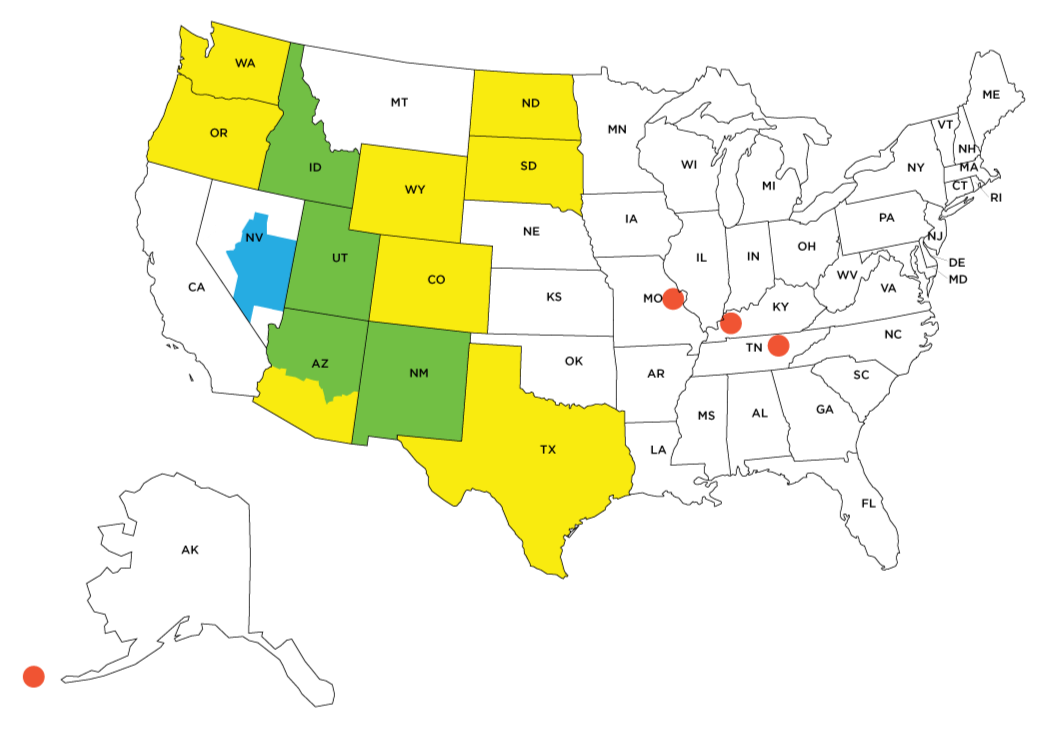
RECA Coverage after 2025 expansion

EXTENDS:
RECA through 2028; Applications are due Dec 31, 2027
The downwinder eligibility period from 1958 to 1962
The uranium worker eligibility period from 1971 to 1990
STRENGTHENS:
Geographic downwinder area to entire states of Utah, Idaho, and New Mexico, and now includes all of Mohave County in Arizona
Compensable diseases for uranium miners to include renal cancers and other chronic renal disease including nephritis and kidney tubal tissue injury
Compensable diseases for downwinders by removing age restrictions for leukemia claims
Coverage to include uranium core drillers and remediation workers, and to allow for combined work histories
CREATES:
Eligibility for communities in Missouri, Kentucky, Tennessee, and Alaska exposed to radioactive waste storage
Specific eligibility periods for Downwinders in New Mexico due to the Trinity Test
ADDITIONAL BILL RESOURCES
Previous Legislation
-
In 2000, Congress added new categories to RECA through the Radiation Exposure Compensation Act Amendments of 2000. This amendment added two new claimant categories (uranium mill and ore workers), added new geographic areas, included new considerations for Indigenous communities and established RESEP clinics. These clinics provide free screenings to RECA claimants, leading to earlier detection.
-
As early as 2005 representatives and communities have worked to extend and strenghten RECA. In 2010 a comprehensive bill was introduced by Senator Udall (D-NM) and Representative Ben Ray Lujan (D-NM)(S.3224/H.R.5119)
In 2009 Sen. Crapo (R-ID) introduced S.1342, calling for the inclusion of Idaho and Montana under RECA. There was no similar house bill at the time.
In 2010, Sen. Udall introduced another set of amendments (s.3224) that would have, among other things
Included new areas in CO, ID, MT and NM;
Increased compensation to claimants
In early 2017 Senator Crapo introduced S.197, alongside Senators Udall , Risch (R-ID), Heinrich (D-NM), Bennet (D-CO) and Booker (D-NJ), seeking similar inclusions.
In 2018, Crapo led a hearing in the Senate on the bill, bringing Downwinders to Congress to testify. This would be one of the last times RECA was discussed on the floors of Congress until Senator Hawley began campaigning for the extension in earnest in 2023.
-
In 2010 Sen. John McCain (R-AZ) and Rep. Trent Franks (R-AZ) introduced S.3270 / H.R.4712. This bill would have extended coverage to Mohave County, AZ.
In 2021, the Downwinders Parity Act (S. 2012 / H.R. 612) was introduced by Sen. Sinema (D-AZ) and Rep. Stanton (D-AZ), to include downwinders in Clark County, NV and Mohave County, AZ.
A similar act, H.R. 538 was also introduced by Rep. Gosar (R-AZ)
-
In 2021 Senator Lee (R-UT) also introduced S. 2825, the Downwinders Act. This bill would have:
Extended RECA until 2031, or 2032
Extended coverage to all of Utah, and ten counties in New Mexico, and expanded the eligibility period for Trinity downwinders
Required a report to Congress on radioactive fallout.
-
-
In 2023 Sen. Cynthia Lummis (R-WY) introduced S.1681, the Uranium Miners and Workers Act of 2023. This bill would have:
Extended RECA and additional 4 years, until 2027
Extended the uranium industry claim period through 1978
Included those employed as core drillers
Added renal cancer and chronic renal disease to the list of illnesses
-
Thanks to the tireless work of impacted communities, Senator Crapo (R-ID), Senator Lujan (D-NM), and Senator Hawley (R-MO) introduced S. 3853, the Radiation Exposure Compensation Reauthorization Act, in 2024.
Their proposal would have strengthened RECA and better cover those harmed by:
Extending RECA by 6 years;
Increasing payments to $100,000 for all claimants;
Adding downwind eligibility for all of Colorado, Idaho, Montana, New Mexico, Guam, Arizona, Nevada, and Utah, which were shown to have received high levels of fallout from nuclear testing (see map below);
Extending the period for uranium worker eligibility from 1971 to 1990, and adding uranium core drillers and remediation workers;
Adding chronic lymphocytic leukemia as a compensable disease for downwinders and atomic veterans, and adding renal (kidney) diseases as compensable diseases for uranium workers; and
Extending coverage to communities exposed to nuclear waste in Missouri, Alaska, Tennessee, and Kentucky.
On March 7, 2024, this bill passed in the Senate with a vote of 69-30. It was never scheduled for a vote in the House, and RECA expired in July 2024.
Though RECA was significantly expanded in 2025, the expansion did not include all of these provisions.
